Pavilion Publishing and Media Ltd
Blue Sky Offices Shoreham, 25 Cecil Pashley Way, Shoreham-by-Sea, West Sussex, BN43 5FF, UNITED KINGDOM
Tel: +44 (0)1273 434 943
Email: [email protected]


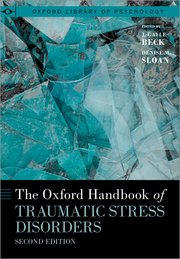
The Oxford Handbook of Traumatic Stress Disorders
Edited by J. Gayle Beck and Denise Sloan
Second edition (Published February 2023)
ISBN 978-0-19-008822-4
Price £97
This is not your typical Oxford Handbook, with its expected vinyl cover, which can slip easily into a case or handbag and is of relatively small dimensions, often considered a true handbook. This is a large, hardback book that runs to over 1000 pages and is of substantial size. It is a member of the Oxford Library of Psychology and is a highly specialised and detailed review of traumatic stress disorders.
This is a serious and detailed look at traumatic stress disorders, which includes Post Traumatic Stress Disorder (PTSD). Although the condition of PTSD has been understood for some time, the official recognition of the diagnostic criteria was surprisingly only codified in 1980. Now that PTSD is in mainstream literature, I found Chapter 21, Page 546 very interesting, and it looks at PTSD in a non-Western culture. It is a thoughtful and thought-provoking insight that points out trauma can affect everyone on this planet.
This book is aimed at people who deal with traumatic stress disorders professionally (could be clinical, academic, or even as a patient who wants a reliable and detailed account) and who want a one-stop, thorough, scholarly review of the topic.
There is a vast range of contributors, with many from the United States, as well as some from other parts of the world. The book is primarily text-driven, with numerous references. It delves into the subject in great depth, making it a valuable resource for clinicians and clinics that treat individuals with traumatic stress disorders. I would imagine that if you could read the whole of this book, which would be a considerable undertaking, then you would have a bird’s eye view of the whole topic expressed in the title.
There are 40 chapters, and likely, people will selectively read the relevant chapters, which may be more manageable for a busy person who will use the rest of the book as a reference source. One benefit of a deep dive into a topic is that you can gain some fascinating insights. For example, on page 174, I was surprised to learn that in young people, the genesis of PTSD may have a contribution from genetic factors.
It is not a book that lends itself to a brief review of the topic. Although the book is not cheap, it represents an excellent one-stop shop review of an important topic. It would be nice to have access to a digital version that can be viewed on a smartphone, which can be very handy in solving a clinical problem when it arises. Having the answer on a mobile device can be very useful, and hopefully in editions to come, this will become available.
That is a minor criticism of an impressive book, and if you have a deep interest in the field of traumatic stress disorder, then this book is well worth a look.

This website uses cookies to improve your experience. We'll assume you're ok with this, but you can opt-out if you wish. Accept Read more ...

